
Fluency Development
Key Concepts
Fluency is crucial to reading comprehension.
A strong research and theoretical base indicates that, while fluency in and of itself is not sufficient to ensure high levels of reading achievement, it is absolutely necessary as a basis for reading achievement. This is because without fluency (the fast and accurate recognition of words), reading comprehension is difficult to achieve.
Fluency must be assessed and monitored.
The essential skills for fluency should be assessed regularly. As early as kindergarten, student progress in learning letter-sound correspondence and the ability to blend sounds to form words should be continuously measured. Beginning in 1st grade, whole word reading of both regular and irregular words and progress in oral reading of connected text must be assessed. Based on these ongoing assessments, decisions should be made about whether student progress in these essential skills is satisfactory or not.
Passage fluency is an effective indicator of English reading performance for English only students and English learners (ELs) who are being taught to read in English.
The value of passage fluency as an indicator of overall reading proficiency is its moderate to strong association with reading comprehension. Therefore, practicing passage fluency helps increase comprehension, and at the same time practicing comprehension strategies may also help increase passage fluency (Baker, Stoolmiller, Good, & Baker, in preparation; Jenkins, Fuchs, van den Broek, Espin & Deno, 2003; Klauda & Guthrie, 2008).
Explicit fluency instruction must be provided to students at their instructional reading level.
Students need a high degree of accuracy with text (sounds, words, and passages) before focusing on developing speed. A problem with some fluency instruction is that students are asked to read text that is too difficult, which encourages guessing. For some students, fluency should continue to be an explicit instructional focus through grade 8 and beyond.
Essential features of effective instruction should be applied to fluency instruction.
Effective fluency instruction should include teacher modeling, followed by multiple opportunities for students to practice. Students should receive direct, continuous feedback and their progress toward goals should be carefully monitored. Activities to improve fluency should actively engage students and encourage their efforts.
For ELs, practicing fluent word reading or text reading may not be sufficient to increase passage fluency.
In the absence of robust vocabulary and comprehension instruction, practicing fluent word reading or text reading alone may result in reading rate increases without corresponding increases in overall reading proficiency (Pikulski & Chard, 2005, Baker, Stoolmiller, Good, & Baker, in preparation).
Cross-Linguistic Transfer of Reading Skills for Children Learning to Read in English and Spanish
Explore the following PowerPoint to see which reading skills transfer well from Spanish to English and which do not.
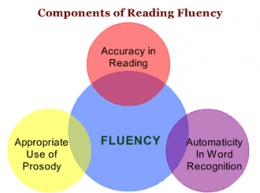
Accuracy, speed and prosody are the three essential components of fluent reading.
Students must first develop accuracy with letter-sound correspondence, and then whole word reading to successfully decode text. Once accuracy is established, students build speed and prosody into their oral reading through daily practice.
Professional Development Presentation
Understanding that fluency is not speed-reading, and knowing how to assess and teach fluency, is critical to improving reading instruction at all levels. In addition to explaining the component skills necessary, this presentation provides an overview of the research on and rationale for assessing and teaching reading fluency. Several practical tools for planning fluency instruction are included, as well as helpful resources and hands-on practice activities.
Apply the Concepts
Practice Activities
1. Assessing Fluency with Connected Text - Case Scenarios
For each "Oral Reading Fluency Probe" calculate the total score, accuracy, and make some general instructional implications about students’ skills in accuracy and fluency with connected text. Discuss your answers with colleagues.
2. Whole Class Fluency Practice Activities
These resources focus on having students practice the components of fluency: accuracy, prosody, and rate. Use the first activity to increase student’s oral reading fluency during whole group or small group instruction.
Dr. Anita Archer is a nationally known educational consultant and has presented on effective instruction and the components of literacy. For the next activities, Dr. Archer demonstrates a few fluency practice routines used during whole class passage reading. Watch the Alternative Passage Reading video and identify the type of reading procedures Dr. Archer models and the effective instructional methods used to engage students.
Video available at: http://www.scoe.org/pub/htdocs/rla-media.html under "Alternative Passage Reading, 3rd grade"3. Application Activity: Identifying SBRR in Practice
Analyze lessons from your core reading program to determine if critical elements of fluency instruction appear or if they need to be enhanced. Discuss your possible answers with colleagues.
Resources
1. Letter-Sound Automaticity: The 1 Minute Dash
This activity is designed to build automaticity at the letter-sound level. Use with individuals or small groups. Use after students are accurate, but not yet fluent with identifying the letter sound.
2. Letter-Sound Automaticity: Fluency Sounds Chart
Use the template with students to practice timed readings with letter-sound correspondence.
3. Building Automaticity Example: No Peeps
“No Peeps” is a practice tool designed to increase the beginning blending skills of young students in late kindergarten and throughout first grade.
4. Word Reading Automaticity: 5x5 Dash
The 5x5 Dash is an activity designed to build fluency at the word level. These should be high-utility or high-priority words. Students should be able to identify target words accurately, but not necessarily fluently. If student cannot accurately identify a word, the teacher should use direct instruction to teach the word.
5. Rapid Reading Word Chart
Use the template with students to practice timed readings with sight words or targeted word families.
6. Guidelines for Developing Individual Strategy: Repeated Reading
This resource provides guidelines, reminders, and discussion of setting goals when using the strategy of repeated readings to develop reading fluency.
7. Connected Text Automaticity; Partner Reading
This tool outlines considerations for planning fluency instruction with connected text with partner reading. Included are guidelines for selecting partners, information on training students in partner reading, and sample routines for using "Partner Reading Fluency".
Links
1. Florida Center for Reading Research Student Activities
This is a link to the Florida Center for Reading Research (FCRR) Student Center Activities. The fluency activities can be used for whole group and small group instruction. Use the search tool on the link below to find and print specific instructional routines or student center activities and their accompanying activity masters by grade level.
2. Drop Everything and Read—But How? Jan Hasbrouck
Your school has had a long tradition of using sustained silent reading to increase student’s fluency with inconsistent results. Your school now wants to participate in implementing more research-based strategies to reach fluency outcome goals. This article will help you explore the drawbacks of silent reading and will describe methods to enhance fluency and increase students comprehension.

